PRESS RELEASE
JEFFERIES LAND CONSERVATION TRUST
Council scupper bid for funds to improve Jefferies Museum
Efforts to raise money from the Heritage Lottery Fund, to restore the grounds and out-buildings of the Richard Jefferies Museum at Coate, have been dealt a mighty blow through lack of support and commitment to the project by Swindon Borough Council.
The Jefferies Land Conservation Trust submitted a bid for funding in May after an officer from the national lottery body had visited the Museum and expressed delight at the proposals. Plans included restoring the little dairy, the pig-sties and barn as well as planting up the grounds with wild-life friendly flowers, trees and shrubs.
As Swindon Borough Council own the house, where nature writer Richard Jefferies [1848-1887] was born and raised, part of the requirement for funding depended on the Trust securing a 15 year lease and an access agreement. The council has been aware of this since March but no progress has been made to secure any written support for the proposals.
Jean Saunders, Secretary of the Trust said:
"We are bitterly disappointed to miss out on the funding but we will try again. The Museum has been transformed since volunteers have been working in the grounds. Apart from a grant of £500 from Royal Mail to buy plants, people have been willing to dip into their own pockets and give up their free time to beautify the place."
"I don't get it. The Council is quick to react to accusations that Swindon is a cultural desert. Yet on their doorstep they own a charming little Museum that was the home of one of England's finest nature writers but they won't spend a penny on it and do nothing to assist those who are prepared to help."
The Museum, on the corner of Day House Lane and the Marlborough Road at Coate, is opened by the Richard Jefferies Society on the first and third Sundays of the month between 2-5pm until the end of September and the second Wednesday of the month from 10am-4pm throughout the year.
Monday, July 24, 2006


Tuesday, June 06, 2006
SUMMER NEWSLETTER 2006
The last six months in a nut-shell – pain, gain and rain…
It seems that since our official inauguration last December, time has been taken up with some tedious jobs that had to be done. The Jefferies Land Conservation Trust [JLCT] has been accepted as a registered charity and as an Environmental Body able to apply for Landfill Tax Credits for approved environmental projects. Also, we have registered for Gift Aid. Many thanks to those of you who have filled in Gift Aid authorisations that will increase your donation’s value by about a quarter. If there is a gift-aid form included with this newsletter, it means that you haven’t filled in a form yet but there is still time to do so! There have been some extremely generous donations made by Members and, all in all, we have not wasted a penny.
We have submitted applications for funding from the Lottery Heritage Fund and from Biffawaste for up to £100,000 with a view to restoring the grounds and out-buildings attached to Richard Jefferies’ birthplace and home at Coate. This project would go someway to meeting our own aims whilst enhancing the environmental, historic and educational potential of the Museum. The application process has included umpteen meetings, books of forms to complete, surveys and a reluctance on the part of Swindon Borough Council [SBC] to help, even though they aren’t interested in doing the work themselves. JLCT lodged a formal complaint about the state of the Museum property that has belonged to SBC since 1926. During this time, the council has pulled down buildings, sold off much of the land to development and attempted to destroy more, albeit that Sir John Betjeman, Spike Milligan et al stepped in with a major national appeal that saved the barn/pig sties and dairy from certain destruction. The pretty little thatched cottage, that has been used to house the caretaker, has been empty for over ten years whilst SBC’s answer to many of the repeated attacks by vandals is just to board up doors and windows. On top of this, for the last 20 years, volunteers from the Richard Jefferies Society have kept the Museum open to the public. They are expected to clean the place in the bargain. If you haven’t ever visited the Museum for a while, you are in for a treat [see enclosed leaflet for more information].
With this history in mind, our application for funding is very much in line with the Richard Jefferies Society’s hopes for the Museum. The aim is to restore the out-buildings to how they might have looked in Jefferies’ time and house appropriate farming equipment to demonstrate their use. The gardens would reflect Jefferies’ passion for nature and restore many of the features flagged up in his writing. Finally a two-year part-time post would be created to ensure that the Museum is opened on a more regular basis and that appropriate workshops can be run related to nature, literature and social history.
It will take until about October before we find out if our bid for funds is successful and assuming that we succeed, we shall need to obtain listed building consent for work on the dairy, barn, walls, paths and fences and an agreement with SBC to provide JLCT with a 15 year lease. The last requirement is likely to be the most difficult but we have already put the wheels in motion to achieve this.
In the meantime, thanks to the assistance of volunteers drawn from both the JLCT and the Richard Jefferies Society, the gardens of the Museum are already taking shape. Whilst brambles and nettles can be good for wildlife, too much of the wrong thing in the wrong place can be regarded as pollution! This was the case at the Jefferies Museum where everything was smothered. Carmela Masi secured a grant from Royal Mail to buy plants and trees worth £500. Now there is colour in the flower beds where there was none before whilst old English varieties of fruit trees have been planted in the orchard.
If anyone can help spend some time gardening or donate plants that the slugs won’t chew up, we would like to hear from you. Alternatively, if you would like to make a specific donation for plants, please contact us at the registered address at the end of the newsletter. The Richard Jefferies Society would also value your assistance with regard to helping out at the Museum. The more volunteers, the more that the Museum can be opened up. Please contact us even if you can only help a little. Remember that wise saying by Edmunde Burke: Nobody made a greater mistake than he who did nothing because he could only do a little.
Simon Bridewell is hoping to engage about 40 volunteers from Nationwide to work in the grounds on a 2-3 day project in the late summer. This will provide a great boost to the project regardless of whether we are successful in our bid for funds.
In the meantime, we can’t thank volunteers enough for all their help so far and for the rain that has assisted in the care of our plants and trees.
The Save Coate campaign.
There has been a bit of a breathing space with regard to the Coate development proposals. Over a year later, the planning application to build nearly 2000 houses, university buildings and business premises next to Coate Water still sits on the planners’ desk. Whilst the principle for development has been accepted by various government planning inspectors, the planning application goes against what the inspectors view as acceptable development of the land. The Swindon Gateway Consortium, made up of Redrow Homes, Persimmon Homes, University of Bath and the Swindon & Marlborough NHS Trust, are expected to withdraw or amend their current outrageous plans that do not provide for adequate protection of Coate Water nature reserve, nor the open countryside views to and from the Downs nor other ecological or historic features, whilst Richard Jefferies is still treated as a nonentity. If English Nature’s buffer is accepted as a minimum for the Coate Water nature reserve, whilst it does not meet our requirements, it might give us some sort of bargaining tool to ensure that this land is managed and protected in order that it enhances the Site of Special Scientific Interest forever and isn’t used as an excuse to expand as soon as the developers run out of space. JLCT has asked that any land provided for buffer use, whether this relates to the three nature reserves in the area, the otter streams, the archaeological features or the views, should be given to JLCT. We have also lodged a formal objection to SBC with regard to their draft planning guidance on seeking developer contributions. The council see development as a means to fund other community facilities in the town. Fair enough, but with regard to their requirements for leisure and cultural facilities, the Jefferies Museum and Coate Water aren’t even mentioned. Keep a close watch on the Save Coate web site www.savecoate.org.uk and the links to keep up to date with campaign news.
Alternative Use of Jefferies Land
The response from councillors with regard to the Trust’s proposal for the alternative use of the Coate development area has been met with stunned silence. There has been no feedback at all and no interest in our proposals. Alan Hayward asked this question to Cabinet on 18th January 2006.
The Jefferies Land Conservation Trust objected to the proposed changes to the Structure Plan related to major development at Coate. The policy conflicted with the Trust's alternative proposals for the area. The Structure Plan Authorities rebutted the objection on the grounds that the document had not been subjected to public consultation. Albeit that the vision has undergone limited consultation and the final copy has been sent to all councillors, we ask whether councillors have read the pamphlet and would they not agree that the proposals contained within the document would offer Swindon a far greater vision for the future of Swindon than that offered by the Swindon Gateway Consortium?
Given that the Structure Plan Authorities did not go through a debate about whether Coate was a suitable location for a university, housing and offices before committing the land to development in the Structure Plan review, are the views of over 26,000 people who have signed a petition in objection to the proposals to be ignored?
Essentially we were told by Councillor Bluh that our vision for the land was commendable, but it was pie-in-the-sky. As the only obstruction is developers’ greed and the University of Bath’s dogmatic stance, we see our proposals as not only practical but vital to the good health of Swindon.
Membership
Given that we haven’t had a chance to promote a membership drive, it is good to report that we now have nearly seventy members. Some are local, some national and two members live in Canada. The John Chandler report on Coate and Richard Jefferies that JLCT paid to have printed has been widely circulated and has been well-received. Copies can be picked up from the Jefferies’ Museum and the Coate Water Rangers’ centre along with membership forms.
Thanks to Patrick Esmonde in Canada, the JLCT has forged a relationship with the Biennial John Burroughs Nature Writing Conference held at the Oneonta Campus of the State University of New York. The Nature Writing Section of the English Department at Oneonta sponsors these Seminars. John Burroughs (1837-1921) is a renowned American nature writer whose works, like Jefferies, were topographical and linked closely to the landscape of his particular region, i.e. the Catskill Mountain area in mid NY State. Patrick encouraged John Chandler to submit his report to conference. We were delighted to learn that the paper was accepted by conference but, unfortunately, John is not in a position to be able to present it in person.
Friday, April 28, 2006
Grant to plant
The Royal Mail has awarded the Trust a grant of £500 in order to buy flowers, herbs, shrubs, bulbs and fruit trees for planting out in the grounds of Jefferies Museum at Coate.
A work party started the beautifying process on Sunday 23rd April.
Watch this space to see the transformation.
A work party started the beautifying process on Sunday 23rd April.
Watch this space to see the transformation.
Tuesday, March 28, 2006
MYSTERY METAL ARMY FOUND AT COATE FARM

PRESS RELEASE
MYSTERY METAL ARMY FOUND AT COATE FARM
An army of metal figurines was found in the gardens of Richard Jefferies’ old house and Museum at Coate on 21 March 2006. It is a mystery how they got there or whether they were left as a tribute to the Victorian writer whose work is still much admired today.
Thirty small figurines, an inch or so in height, of archers and warriors armed with pikes, some on horseback, were discovered behind a Copper Beech tree under leaf mould; each one separately wrapped in a small plastic bag and, almost certainly, left deliberately.
Jean Saunders, secretary of both the Jefferies Land Conservation Trust and the Richard Jefferies Society made the discovery during a litter pick of the grounds. She said:
“The Copper Beech was one of Jefferies’ favourites along with the Mulberry tree nearby. I was partly admiring the trees and the bulbs in flower when I spotted a bit of plastic partly buried in the ground. On closer inspection, I found a small hoard of little bags each containing Roman-looking figures. They are not that old but the steel pins have gone rusty. My gut feeling is that someone made a special pilgrimage to Jefferies’ home and left these figures as a memorial to a much-loved and greatly admired writer.”
Richard Jefferies (1) wrote at least three novels that featured battles. The best known is Bevis , a boys adventure story based around Coate where the local lads have a mock Roman war. A Summer House, that no longer exists but which was next to the Copper Beech [2], was the place where Bevis used “an old chair- the back gone-which did very well for a table” to kneel down and draw his map of the campaign. In After London the main character, Felix, makes a voyage across a lake, based on Coate Water, in a land where people have relapsed into barbarism after London is destroyed by pollution.
The figures are now inside the Museum where visitors can use their own imagination as to how they got there.
The Museum is open by special arrangement by contacting Mrs Saunders on 01793 783040 but the first official opening day is Sunday 7th May between 2pm to 5pm.
Editor’s notes:
(1) Richard Jefferies [1848-1887] lived at the old house at Coate until his late twenties. His works are still much read today. Q.D. Leavis, the leading literary authority, described Jefferies as a ‘many sided genius’. He is cited by historians as an authority upon agriculture and rural life in Victorian England; he is anthologised and discussed in major studies of mysticism; he is known as the author of one of the great novels for boys, as well as the author of several highly original novels for adult readers; and he is recognised as one of the greatest nature writers in the language. The area around is home at Coate has been known for years as ‘Jefferies Land'.
(2) There is a painting available in electronic format of the trees and Summer House as they were in Jefferies' time.
Wednesday, March 01, 2006
Help save Jefferies Land from Swindon Borough Council
PROPOSED MODIFICATIONS TO THE SWINDON BOROUGH LOCAL PLAN THAT RELATE TO COATE BUILDING PROPOSALS
Apologies if you find this briefing difficult to follow. There is no simple way to explain the situation that currently affects Jefferies Land.
You have until 4.30pm on Wednesday April 5th 2006 to send in any representations to Swindon Borough Council’s Forward Planning, FREEPOST SCE5251, Premier House, Station Road, Swindon SN1 1TZ.
Click
here to go to the Council's main Local Plan web page if you want to read the documents.
The form to submit your comments should be available at Wat Tyler House and Premier House. You can download theform as a small pdf file or you can use the Council's online service .
Each representation made in support or in objection requires the use of a separate form. If you cover all the matters raised in this briefing, you need to obtain about 10 forms.
For more information read more or e-mail jefferiesland@tiscali.co.uk
If nothing else, please send in an objection to Modification 45
++++
Object to Modification No 40
I am one of nearly 30,000 people who signed the Save Coate petition that states: “We, the undersigned, believe that development of the Coate area will have a devastating impact on wildlife at Coate Water nature reserve. It would desecrate an area that has strong historic, literary and recreational attractions and destroy the last remaining pocket of unspoilt countryside close to Swindon. Coate Water Site of Special Scientific Interest contributes to the very best of the rich variety and abundance of wildlife that makes England's nature special and distinct from any other country in the world. We demand that a one kilometre buffer of land is left undeveloped next to Coate Water. We call upon Swindon Borough Council to say NO to development at Coate.”
The number of people who have signed our petition has escalated more than twofold and fourfold respectively since the Local Plan Inquiry and the Wiltshire Structure Plan Examination in Public. The Structure Plan Panel expressed dismay that the public had not been listened to as part of the Structure Plan review whilst the Local Plan Inspector believed that his hands were tied to the Structure Plan decision and the support of Swindon Borough Council over choice of site. This makes a mockery of the development plan process.
I was absolutely clear that the development proposals was not to build on Coate Water Country Park but next to it. However, many people assume that the fields surrounding Coate Water belong to the council and are part of the Country Park; .particularly the Day House Farm field that abuts the northern end of the park. If there was any confusion caused by calling the development area "Coate", this was the reason. To now call the Development Area “Commonhead” causes greater confusion. It is geographically inaccurate. I object to the change of name from Coate to Commonhead – a matter that was NEVER raised as an objection either as part of the Structure or Local Plan process.
**
Community Participation is now the buzz word in government. There has been precious little of that in Swindon with regard to the Coate proposals that have been forced upon us. However as the Brighton and Hove City Council versus University of Brighton planning appeal decision indicates, it is never too late for the Council to make amends. If Swindon Borough Council can reject the emerging land-use policy for housing on Martin’s Farm at this late stage in the development plan process when, as far as we are aware, this was not a contentious issue at the emerging Local Plan stage, it has the power to do likewise with regard to the policies that affect Coate. It would be far better to withdraw now than to allow desecration of land that will affect the most popular part of Swindon and its main recreational attraction. Please delete DS3
**
I object to changes to criterion [b] that fails to take account of the Inspector’s recommended wording. The Inspector notes in paragraph 5.2 of his report that “Its [the University of Bath] intentions are also to retain its facility at Oakfield”. This statement was echoed at the Wiltshire Structure Plan EIP when the Panel reported in paragraph 5.119 of their report: “We heard from the University of Bath that they are committed to maintaining a presence at the Oakfield site”. As such there is no justification for the LPA to delete the Inspector’s recommendation for policy DS3 at point [b] that states that Oakfield Campus will be retained. This echoes what the University of Bath has said that they want. The Oakfield Campus is now important to the Parks area – local people lost their secondary school with a promise of better-things-to-come by way of the University. Its retention is vital. We ask that the Inspector’s recommended wording for DS3 [b] is retained in full.
**
I object to changes to criterion [d]. The planning inspector recommended that 5ha of land should be set aside for hospital expansion. He was informed by the agents for the Swindon & Marlborough NHS Trust that this was all that would be required in the long-term. At the time of the planning application for the hospital at Commonhead, the Trust insisted that the site was large enough to meet their needs – how quickly they were proved wrong despite the public uproar that the hospital would be too small. So why should we now believe the Trust when they say that they will need 5.5ha by 2026? Some hospital expansion would be acceptable given better architecture and height restrictions than currently employed on site. We ask that the Local Planning Authority increases the allocation by 5ha beyond the Inspector’s recommendation to meet the needs of a growing elderly population and a possible town expansion that would add tens of thousands of new houses compared to now.
**
I object to proposed modification related to DS3 [i] and request the addition of one word to clarify the Inspector’s use of the word “respect” It is not clear that the policy refers to respecting the rural landscape and open countryside. The Great Western Hospital is now a very visible building from the listed viewpoints identified by the Inspector both within the Country Park and the Downs. Adding the word RURAL after the word RESPECT would clarify that it is the natural rather than the built environment that needs to be respected.
**
I object to criterion [j] that does not accord with the Inspector’s recommendation. The policy should include the protection and enhancement of “identified foraging areas” of protected species. The point of Local Plan policy is to identify key areas that should be explored as part of any planning permission consideration. As such foraging areas SHOULD be identified as part of planning policy.
+++++
Object to Modification No 45
Paragraphs 10.2 to 10.10 of the Inspector’s report goes into great detail about the need to protect the rural landscape and he stresses the importance of keeping Coate Water as a “Country Park and not an urban park” [paragraph 10.6].
In addition, the Inspector made it very clear [paragraph 10.7] that tree-planting next to the Country Park’s eastern edge, particularly at the northern end, would not be acceptable in mitigation against development. He stressed the importance of the rural open views from Coate Water that would be blotted out with tree planting.
These recommendations should be reflected in the supporting text of the Plan whilst Appendix 3 requires more description to indicate how rural views will be respected where buildings are allowed.
The lame description proposed by SBC in modified paragraph 1.16.9 - “A number of walks have views and routes across and around the site, the most important of which should be retained.”- falls far short of what is required.
Suggest adding, at the very minimum, the Inspector’s wording [paragraph 10.8] that “ any development should be subservient to the views, retaining the visual link between the Park and its rural surroundings and maintaining its rural character… strategic planting does not provide a solution”.
With reference to the width of buffer proposed by English Nature, to protect and enhance Coate Water Site of Special Scientific Interest, the figures quoted by English Nature, to which the Inspector refers, were their MINIMUM required. Originally English Nature requested a PRECAUTIONARY buffer of 500m at which point they were told to look again by the developers! As such the word “precautionary” should be replaced with MINIMUM in the sentence that reads: English Nature favour a precautionary buffer zone of between 100 and 200 metres in width” etc. whilst the text might refer to English Nature’s 500m precautionary buffer. Ask that the words “250m wide” is added before the “D-shaped field” to clarify English Nature’s minimum requirement for this field.
It needs repeating that we believe that the buffer around Coate Water should be up to 1km wide in order to protect the literary, landscape, historic, cultural and ecological qualities of the area and we shall continue to say this until we are blue in the face.
Finally for this section, point out that SBC has failed to take on board the Inspector’s recommendation related to the buffer set out in paragraph 10.18 of his report.
The Inspector says that “Appendix 3 should be expanded to indicate that the buffer to be established before development commences and how it will be protected and managed”. The Borough Council has only talked about the size of buffer that might be required and not the management of it.
Say that the Inspector’s requirement MUST be laid out in Appendix 3. Say that a statement should make clear that development may have to be delayed for several years in order to allow buffer planting and enhancement of the habitat to be established before any building work commences in order to benefit protected species. Say that a condition of development should require any buffer land to be given over to the Jefferies Land Conservation Trust as part of the management process.
++++
Object to Modification 42
This section is related to the phasing in of any proposed town centre University of Bath [UoB] faculty. Unfortunately the Inspector has agreed with SBC that the UoB should not have to phase in the Arts faculty [or any other town centre stand-alone faculty] to tie in with the development of the Coate campus. This is staggering given the importance attached to the presence of a town centre faculty as part of the Urban Regeneration scheme that has been recognised by the Inspector and the Borough Council as vital. Originally it was proposed that the central faculty should be built before Coate but the developers lobbied to get this criterion deleted. The Borough Council has now couched the policy in terms that the town centre faculty should be “phased for completion by the time the campus at Commonhead is fully developed”. This leaves the question of the Central faculty in the air and in doubt as the Coate campus may never be “fully developed”. The plan to accommodate 10,000 students at the Campus is a long term goal for the UoB. The Planning Inspector suggested that a time delivery for the central faculty should be set as a condition to any planning permission granted for the campus. 5 years is often the period set in planning conditions for things to happen. Suggest that this criterion, [ie a condition to build a central faculty or faculties within a given time frame, say 5 years, of granting planning permission for the Coate campus], should be added to Appendix 3. Say that the words “fully developed” give too much lea-way given SBC’s commitment to the urban regeneration scheme and the importance of the central faculty.
++++
Object to Modification 54 on grounds of omission of Inspector’s comment in paragraph 10.18
The Inspector said “that further consideration be given to whether any additional facility beyond the performing arts centre should be located within the town centre without undermining the benefits of focussing activity on the main campus”. SBC has opted to pursue this recommendation with the UoB outside of the Local Plan process. This isn’t good enough. There should be a statement in the Local Plan that refers to an active commitment to look for other University stand-alone facilities in the town centre in the light of the importance of higher education as part of the town centre regeneration scheme and as set down in Regional Planning Guidance for the south west.
+++++
Objection on grounds of omission to Coate development. Inspector’s ref: paragraph 10.11
There is no mention whatsoever of Richard Jefferies and the importance of the area to him in the emerging local plan apart from using the word “cultural interests” in proposed modification 45 that can be supported. Even the Inspector mentioned Richard Jefferies albeit that he said that Jefferies was no Wordsworth or Hardy. However this is a matter of opinion and open to challenge. His view is not based on any evidence. The importance of Jefferies' literary landscape at Coate has been flagged up yet again recently [Spring 2006] in another national magazine,This England . A recent article by Simon Barnes, that appeared in the Times on 7 January 2006 also echoed the same sentiments that Jefferies literary landscape must be protected because of his importance as a topographical writer. It would appear that everyone appreciates Jefferies apart from planners and Swindon Borough Council.
Say that you want the Local Plan Inquiry to be re-opened to look at the impact of development on what is left of Jefferies Land that has already suffered as a result of creeping development of Coate farm. Say that the Jefferies' importance has not been investigated by Swindon Borough Council or the developers interested in the site and that the land has not been subject to the same degree of scrutiny as other potential constraints.
Ask that Appendix 3 should list a criteria that any Environmental Impact Assessment should study the impact of development on the literary quality of the landscape with reference to Richard Jefferies and how any adverse affects might be mitigated. State that no study to this effect has been conducted by the Borough Council or the developers and that, in view of the international importance of this writer, this is a serious failing of the entire Local Plan policy related to the Coate development.
++++
Objection to modification 51; Urban Inset map that identifies 3 new areas for development along Day House Lane.
The changes proposed to add three hatched areas for inclusion under policy DS3 are said to be the result of the Inspector’s recommendation to support PANs 467, 468 and 469. As these Borough Council changes were never subject to public consultation or made known to the general public, I have no idea what was proposed but object to the changes now. The areas that would be included under the Coate development policy cover listed buildings [the out-buildings] at Day House Farm and at Badbury Wick. It includes Medieval settlement land at Badbury Wick that should be covered by ENV5 but isn’t. Finally it includes the Scheduled Ancient Monument of the Neolithic Stone Circle that IS protected by ENV5! . These areas are not subject to negotiation and cannot be developed regardless of whether the house-builders now own the land. These areas need to be excluded from policy DS3 to protect their archaeological, architectural and historic importance.
++++++++
And as a postscript, given again that we are totally opposed to all this, it is difficult to support any of the proposed modifications related to Coate even though, if the development goes ahead, the modifications may need supporting in their own right.
So if you can grit your teeth, you might support the following. You don’t have to give a reason for supporting the modification.
Modification 44 ties in any employment use of land to be linked to the university. The developers don’t like this modification so they will object.
Modification 45 supports protecting environmental interests of the land and buffers and “historic and cultural interests at various locations within the site.” This can be looked at as an opportunity to flag up Jefferies’ interests.
Modification 46 supports the need for a thorough Environmental Impact Assessment of the proposals and the provision of green corridors etc.
Modification 50 supports buffer zones of at least 30m for County Wildlife Sites and at least 10m to water courses. The County Wildlife Sites are Day House Copse and Burderop Wood North. There is also the Nature reserve at Coate Water but this will be subject to its own wider buffer requirement.
Modification 52 supports the removal of a field of archaeological importance from development land at Badbury Wick.
Apologies if you find this briefing difficult to follow. There is no simple way to explain the situation that currently affects Jefferies Land.
You have until 4.30pm on Wednesday April 5th 2006 to send in any representations to Swindon Borough Council’s Forward Planning, FREEPOST SCE5251, Premier House, Station Road, Swindon SN1 1TZ.
Click
The form to submit your comments should be available at Wat Tyler House and Premier House. You can download the
Each representation made in support or in objection requires the use of a separate form. If you cover all the matters raised in this briefing, you need to obtain about 10 forms.
For more information read more or e-mail jefferiesland@tiscali.co.uk
If nothing else, please send in an objection to Modification 45
++++
Object to Modification No 40
I am one of nearly 30,000 people who signed the Save Coate petition that states: “We, the undersigned, believe that development of the Coate area will have a devastating impact on wildlife at Coate Water nature reserve. It would desecrate an area that has strong historic, literary and recreational attractions and destroy the last remaining pocket of unspoilt countryside close to Swindon. Coate Water Site of Special Scientific Interest contributes to the very best of the rich variety and abundance of wildlife that makes England's nature special and distinct from any other country in the world. We demand that a one kilometre buffer of land is left undeveloped next to Coate Water. We call upon Swindon Borough Council to say NO to development at Coate.”
The number of people who have signed our petition has escalated more than twofold and fourfold respectively since the Local Plan Inquiry and the Wiltshire Structure Plan Examination in Public. The Structure Plan Panel expressed dismay that the public had not been listened to as part of the Structure Plan review whilst the Local Plan Inspector believed that his hands were tied to the Structure Plan decision and the support of Swindon Borough Council over choice of site. This makes a mockery of the development plan process.
I was absolutely clear that the development proposals was not to build on Coate Water Country Park but next to it. However, many people assume that the fields surrounding Coate Water belong to the council and are part of the Country Park; .particularly the Day House Farm field that abuts the northern end of the park. If there was any confusion caused by calling the development area "Coate", this was the reason. To now call the Development Area “Commonhead” causes greater confusion. It is geographically inaccurate. I object to the change of name from Coate to Commonhead – a matter that was NEVER raised as an objection either as part of the Structure or Local Plan process.
**
Community Participation is now the buzz word in government. There has been precious little of that in Swindon with regard to the Coate proposals that have been forced upon us. However as the Brighton and Hove City Council versus University of Brighton planning appeal decision indicates, it is never too late for the Council to make amends. If Swindon Borough Council can reject the emerging land-use policy for housing on Martin’s Farm at this late stage in the development plan process when, as far as we are aware, this was not a contentious issue at the emerging Local Plan stage, it has the power to do likewise with regard to the policies that affect Coate. It would be far better to withdraw now than to allow desecration of land that will affect the most popular part of Swindon and its main recreational attraction. Please delete DS3
**
I object to changes to criterion [b] that fails to take account of the Inspector’s recommended wording. The Inspector notes in paragraph 5.2 of his report that “Its [the University of Bath] intentions are also to retain its facility at Oakfield”. This statement was echoed at the Wiltshire Structure Plan EIP when the Panel reported in paragraph 5.119 of their report: “We heard from the University of Bath that they are committed to maintaining a presence at the Oakfield site”. As such there is no justification for the LPA to delete the Inspector’s recommendation for policy DS3 at point [b] that states that Oakfield Campus will be retained. This echoes what the University of Bath has said that they want. The Oakfield Campus is now important to the Parks area – local people lost their secondary school with a promise of better-things-to-come by way of the University. Its retention is vital. We ask that the Inspector’s recommended wording for DS3 [b] is retained in full.
**
I object to changes to criterion [d]. The planning inspector recommended that 5ha of land should be set aside for hospital expansion. He was informed by the agents for the Swindon & Marlborough NHS Trust that this was all that would be required in the long-term. At the time of the planning application for the hospital at Commonhead, the Trust insisted that the site was large enough to meet their needs – how quickly they were proved wrong despite the public uproar that the hospital would be too small. So why should we now believe the Trust when they say that they will need 5.5ha by 2026? Some hospital expansion would be acceptable given better architecture and height restrictions than currently employed on site. We ask that the Local Planning Authority increases the allocation by 5ha beyond the Inspector’s recommendation to meet the needs of a growing elderly population and a possible town expansion that would add tens of thousands of new houses compared to now.
**
I object to proposed modification related to DS3 [i] and request the addition of one word to clarify the Inspector’s use of the word “respect” It is not clear that the policy refers to respecting the rural landscape and open countryside. The Great Western Hospital is now a very visible building from the listed viewpoints identified by the Inspector both within the Country Park and the Downs. Adding the word RURAL after the word RESPECT would clarify that it is the natural rather than the built environment that needs to be respected.
**
I object to criterion [j] that does not accord with the Inspector’s recommendation. The policy should include the protection and enhancement of “identified foraging areas” of protected species. The point of Local Plan policy is to identify key areas that should be explored as part of any planning permission consideration. As such foraging areas SHOULD be identified as part of planning policy.
+++++
Object to Modification No 45
Paragraphs 10.2 to 10.10 of the Inspector’s report goes into great detail about the need to protect the rural landscape and he stresses the importance of keeping Coate Water as a “Country Park and not an urban park” [paragraph 10.6].
In addition, the Inspector made it very clear [paragraph 10.7] that tree-planting next to the Country Park’s eastern edge, particularly at the northern end, would not be acceptable in mitigation against development. He stressed the importance of the rural open views from Coate Water that would be blotted out with tree planting.
These recommendations should be reflected in the supporting text of the Plan whilst Appendix 3 requires more description to indicate how rural views will be respected where buildings are allowed.
The lame description proposed by SBC in modified paragraph 1.16.9 - “A number of walks have views and routes across and around the site, the most important of which should be retained.”- falls far short of what is required.
Suggest adding, at the very minimum, the Inspector’s wording [paragraph 10.8] that “ any development should be subservient to the views, retaining the visual link between the Park and its rural surroundings and maintaining its rural character… strategic planting does not provide a solution”.
With reference to the width of buffer proposed by English Nature, to protect and enhance Coate Water Site of Special Scientific Interest, the figures quoted by English Nature, to which the Inspector refers, were their MINIMUM required. Originally English Nature requested a PRECAUTIONARY buffer of 500m at which point they were told to look again by the developers! As such the word “precautionary” should be replaced with MINIMUM in the sentence that reads: English Nature favour a precautionary buffer zone of between 100 and 200 metres in width” etc. whilst the text might refer to English Nature’s 500m precautionary buffer. Ask that the words “250m wide” is added before the “D-shaped field” to clarify English Nature’s minimum requirement for this field.
It needs repeating that we believe that the buffer around Coate Water should be up to 1km wide in order to protect the literary, landscape, historic, cultural and ecological qualities of the area and we shall continue to say this until we are blue in the face.
Finally for this section, point out that SBC has failed to take on board the Inspector’s recommendation related to the buffer set out in paragraph 10.18 of his report.
The Inspector says that “Appendix 3 should be expanded to indicate that the buffer to be established before development commences and how it will be protected and managed”. The Borough Council has only talked about the size of buffer that might be required and not the management of it.
Say that the Inspector’s requirement MUST be laid out in Appendix 3. Say that a statement should make clear that development may have to be delayed for several years in order to allow buffer planting and enhancement of the habitat to be established before any building work commences in order to benefit protected species. Say that a condition of development should require any buffer land to be given over to the Jefferies Land Conservation Trust as part of the management process.
++++
Object to Modification 42
This section is related to the phasing in of any proposed town centre University of Bath [UoB] faculty. Unfortunately the Inspector has agreed with SBC that the UoB should not have to phase in the Arts faculty [or any other town centre stand-alone faculty] to tie in with the development of the Coate campus. This is staggering given the importance attached to the presence of a town centre faculty as part of the Urban Regeneration scheme that has been recognised by the Inspector and the Borough Council as vital. Originally it was proposed that the central faculty should be built before Coate but the developers lobbied to get this criterion deleted. The Borough Council has now couched the policy in terms that the town centre faculty should be “phased for completion by the time the campus at Commonhead is fully developed”. This leaves the question of the Central faculty in the air and in doubt as the Coate campus may never be “fully developed”. The plan to accommodate 10,000 students at the Campus is a long term goal for the UoB. The Planning Inspector suggested that a time delivery for the central faculty should be set as a condition to any planning permission granted for the campus. 5 years is often the period set in planning conditions for things to happen. Suggest that this criterion, [ie a condition to build a central faculty or faculties within a given time frame, say 5 years, of granting planning permission for the Coate campus], should be added to Appendix 3. Say that the words “fully developed” give too much lea-way given SBC’s commitment to the urban regeneration scheme and the importance of the central faculty.
++++
Object to Modification 54 on grounds of omission of Inspector’s comment in paragraph 10.18
The Inspector said “that further consideration be given to whether any additional facility beyond the performing arts centre should be located within the town centre without undermining the benefits of focussing activity on the main campus”. SBC has opted to pursue this recommendation with the UoB outside of the Local Plan process. This isn’t good enough. There should be a statement in the Local Plan that refers to an active commitment to look for other University stand-alone facilities in the town centre in the light of the importance of higher education as part of the town centre regeneration scheme and as set down in Regional Planning Guidance for the south west.
+++++
Objection on grounds of omission to Coate development. Inspector’s ref: paragraph 10.11
There is no mention whatsoever of Richard Jefferies and the importance of the area to him in the emerging local plan apart from using the word “cultural interests” in proposed modification 45 that can be supported. Even the Inspector mentioned Richard Jefferies albeit that he said that Jefferies was no Wordsworth or Hardy. However this is a matter of opinion and open to challenge. His view is not based on any evidence. The importance of Jefferies' literary landscape at Coate has been flagged up yet again recently [Spring 2006] in another national magazine,
Say that you want the Local Plan Inquiry to be re-opened to look at the impact of development on what is left of Jefferies Land that has already suffered as a result of creeping development of Coate farm. Say that the Jefferies' importance has not been investigated by Swindon Borough Council or the developers interested in the site and that the land has not been subject to the same degree of scrutiny as other potential constraints.
Ask that Appendix 3 should list a criteria that any Environmental Impact Assessment should study the impact of development on the literary quality of the landscape with reference to Richard Jefferies and how any adverse affects might be mitigated. State that no study to this effect has been conducted by the Borough Council or the developers and that, in view of the international importance of this writer, this is a serious failing of the entire Local Plan policy related to the Coate development.
++++
Objection to modification 51; Urban Inset map that identifies 3 new areas for development along Day House Lane.
The changes proposed to add three hatched areas for inclusion under policy DS3 are said to be the result of the Inspector’s recommendation to support PANs 467, 468 and 469. As these Borough Council changes were never subject to public consultation or made known to the general public, I have no idea what was proposed but object to the changes now. The areas that would be included under the Coate development policy cover listed buildings [the out-buildings] at Day House Farm and at Badbury Wick. It includes Medieval settlement land at Badbury Wick that should be covered by ENV5 but isn’t. Finally it includes the Scheduled Ancient Monument of the Neolithic Stone Circle that IS protected by ENV5! . These areas are not subject to negotiation and cannot be developed regardless of whether the house-builders now own the land. These areas need to be excluded from policy DS3 to protect their archaeological, architectural and historic importance.
++++++++
And as a postscript, given again that we are totally opposed to all this, it is difficult to support any of the proposed modifications related to Coate even though, if the development goes ahead, the modifications may need supporting in their own right.
So if you can grit your teeth, you might support the following. You don’t have to give a reason for supporting the modification.
Modification 44 ties in any employment use of land to be linked to the university. The developers don’t like this modification so they will object.
Modification 45 supports protecting environmental interests of the land and buffers and “historic and cultural interests at various locations within the site.” This can be looked at as an opportunity to flag up Jefferies’ interests.
Modification 46 supports the need for a thorough Environmental Impact Assessment of the proposals and the provision of green corridors etc.
Modification 50 supports buffer zones of at least 30m for County Wildlife Sites and at least 10m to water courses. The County Wildlife Sites are Day House Copse and Burderop Wood North. There is also the Nature reserve at Coate Water but this will be subject to its own wider buffer requirement.
Modification 52 supports the removal of a field of archaeological importance from development land at Badbury Wick.
Tuesday, January 31, 2006
A picture paints a thousand words
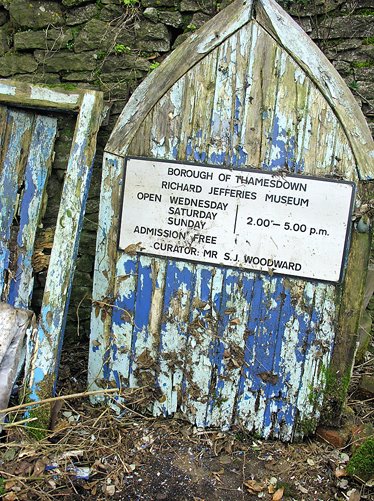
On a bitterly cold day, a dedicated team of nearly 20 volunteers gave up their Sunday to start clearing the brambles and nettles at Coate Farm.
This old door was found hidden behind the overgrowth.
Doesn't it say it all?
Anyone prepared to help return Jefferies' home to its former glory should contact us. More work days are planned.
Wednesday, January 04, 2006
30 years - History repeats itself

Coate Farmhouse and its out-buildings are in a very poor state at the moment. The Trust has lodged a formal complaint with Swindon Borough Council, the owners of the Grade II listed building, asking that restoration is undertaken now.
There was a similar appeal launched in 1975 by Sir John Betjeman. Mark Daniel's sketch of the farmhouse and outbuildings is illustrated above.
COATE FARM APPEAL 1975
An appeal by Sir John Betjeman with
Richard Adams
Ronald Blythe
Robert Dougall
Spike Milligan
Johnny Morris
Henry Williamson – Vice-president Richard Jefferies Society
Coate Farm, near Swindon, where writer Richard Jefferies was born and spent most of his short life, is in great danger through decay. Several thousand Pounds are needed urgently if the outbuildings are to be saved. This place is important for two reasons:
First, most of the remaining buildings have survived from before the middle of the last century, gaining importance from Jefferies’ descriptions of the farm, the countryside and its people during a period critical to English rural life;
Secondly, Jefferies’ work has been a source of inspiration to imaginative people for a hundred years and has profoundly affected modern country writing.
Parts of the farmhouse date from about 1700 but the outbuildings were constructed by Jefferies’ father, James, about 1840, largely with his own hands. At a time when agricultural depression was forcing many small dairy-farmers off the land, James hung on grimly – and built to last. Eventually he was ruined but his patience with young Richard, who preferred scribbling in notebooks to physical work, gave the world a great writer. The old buildings stand as a monument to a brave farmer and his son, whose vision helped inspire some of the best literature in the world.
It sometimes happens that Scheduled buildings are restored by some official body particularly if, like Coate Farm, they are actually owned by the local authority. However, the Council cannot now spend money on work to which it is not already committed – and the buildings cannot wait. Private support is the only hope.
I would be most grateful if you would help to save Coate Farm by sending a donation to: The Coate Farm Restoration Fund
c/o Mark Daniel etc
Tuesday, January 03, 2006
Western Daily Press
BATTLE OF THE LITERARY GIANTS (OR WAS ONE A PYGMY?)
3 January 2006
A Row over the merits of 19th century West Country literary giants Thomas Hardy and Richard Jefferies has gone all the way to Deputy Prime Minister John Prescott. It was sparked after Planning Inspector David Fenton's views on eminent Victorian nature writer Richard Jefferies enraged an appreciation group formed in his home town of Swindon.
The Richard Jefferies Society is fighting to prevent wildlife-rich countryside, known as Jefferies Land, from being destroyed by a £500million development on the edge of Swindon.
A university, offices and 1,800 homes are proposed for 500 acres of fields around the hamlet of Coate, an area objectors say was immortalized by the writings of Jefferies, who lived there. The society insists the area is part of Swindon's cultural heritage and as such should be preserved.
But after examining its objections, Mr Fenton felt the land could be developed. His report said: "To some people Jefferies and his works are an integral part of the literary landscape of Britain.
"However, it seems to me that he is not known or thought of in the same way as more major figures such as Hardy or Wordsworth." The society has now written to Mr Fenton's boss Mr Prescott, challenging his decision that Jefferies writings should have no bearing on the proposals.
The letter points out that Jefferies (18481887) was recently voted "by far the most frequently nominated author" when he came third in a national poll to find Britain's most popular nature writer.
This, the society notes, was higher than both Wordsworth and Hardy, whose works were also inspired by the West Country.
Jefferies society member Jean Saunders wrote: "We are dismayed to read the inspector's views related to the lack of weight he has afforded to the special quality of the literary landscape of land at Coate." She said Jefferies Land is a "most valued landscape" in terms of planning policy guidelines regarding the quality of life and the environment in rural areas.
THE letter goes on: "Given that Swindon has such a poor cultural image in Britain, when it has such an important and influential figurehead born and bred at Coate, we are at a loss to understand the inspector's point of view.
"We request that you might explore our concerns as we believe a major constraint to development has been summarily dismissed." To help guide Mr Prescott's deliberations, the society has sent him a copy of a new publication, Coate and Richard Jefferies by John Chandler. The Save Coate campaign has collected 26,000 signatures in its battle to protect Jefferies Land, which lies next to Coate Water Country Park.
In September, campaigners launched the Jefferies Land Conservation Trust which is seeking an alterative use for the rural site, situated near Junction 15 of the M4 and the Great Western Hospital.
The trust says the land should be preserved "for visitors to enjoy a special rural climate, and as a centre for study of the environment and historic landscapes". But the University of Bath in Swindon says it is the only viable site for its campus and denies campaigners' claims that it could be built in the town centre.
It has linked up with developers whose proposed 1,800 homes and commercial park will finance the infrastructure for the university, including sewers and roads. This Gateway scheme will also help fast-growing Swindon fill its Government housing quota for the next few years, says the council.
Richard Jefferies (1848-1887)
BEST known for his prolific and sensitive writing on natural history, village life and agriculture in late Victorian England, Jefferies' career also revealed a many-sided author who was something of an enigma.
Some associate him with the children's classic Bevis or the strange futuristic fantasy After London. But his finest work, including his autobiography The Story of my Heart, was inspired by the countryside around Coate, near Swindon, where he grew up and spent much of his life.
He is cited as an inspiration to a number of better known writers including John Fowles, who lived in Dorset, and A A 'Christopher Robin' Milne.
Thomas Hardy (1840-1928)
Poet and novelist born in Dorchester, Hardy created the literary region of Wessex, based in an around Dorset, where many of his stories are set.
His career as writer spanned more than 50 years, during which he wrote classic novels including Far From the Madding Crowd, Tess of the D'Urbervilles, The Mayor of Casterbridge and Jude The Obscure.
His novels bravely challenged many of the sexual and religious conventions of the Victorian age, and dared to present a bleak view of human nature.
In his poems, Hardy depicted rural life without sentimentality - his mood was often stoic and gloomy.
BATTLE OF THE LITERARY GIANTS (OR WAS ONE A PYGMY?)
3 January 2006
A Row over the merits of 19th century West Country literary giants Thomas Hardy and Richard Jefferies has gone all the way to Deputy Prime Minister John Prescott. It was sparked after Planning Inspector David Fenton's views on eminent Victorian nature writer Richard Jefferies enraged an appreciation group formed in his home town of Swindon.
The Richard Jefferies Society is fighting to prevent wildlife-rich countryside, known as Jefferies Land, from being destroyed by a £500million development on the edge of Swindon.
A university, offices and 1,800 homes are proposed for 500 acres of fields around the hamlet of Coate, an area objectors say was immortalized by the writings of Jefferies, who lived there. The society insists the area is part of Swindon's cultural heritage and as such should be preserved.
But after examining its objections, Mr Fenton felt the land could be developed. His report said: "To some people Jefferies and his works are an integral part of the literary landscape of Britain.
"However, it seems to me that he is not known or thought of in the same way as more major figures such as Hardy or Wordsworth." The society has now written to Mr Fenton's boss Mr Prescott, challenging his decision that Jefferies writings should have no bearing on the proposals.
The letter points out that Jefferies (18481887) was recently voted "by far the most frequently nominated author" when he came third in a national poll to find Britain's most popular nature writer.
This, the society notes, was higher than both Wordsworth and Hardy, whose works were also inspired by the West Country.
Jefferies society member Jean Saunders wrote: "We are dismayed to read the inspector's views related to the lack of weight he has afforded to the special quality of the literary landscape of land at Coate." She said Jefferies Land is a "most valued landscape" in terms of planning policy guidelines regarding the quality of life and the environment in rural areas.
THE letter goes on: "Given that Swindon has such a poor cultural image in Britain, when it has such an important and influential figurehead born and bred at Coate, we are at a loss to understand the inspector's point of view.
"We request that you might explore our concerns as we believe a major constraint to development has been summarily dismissed." To help guide Mr Prescott's deliberations, the society has sent him a copy of a new publication, Coate and Richard Jefferies by John Chandler. The Save Coate campaign has collected 26,000 signatures in its battle to protect Jefferies Land, which lies next to Coate Water Country Park.
In September, campaigners launched the Jefferies Land Conservation Trust which is seeking an alterative use for the rural site, situated near Junction 15 of the M4 and the Great Western Hospital.
The trust says the land should be preserved "for visitors to enjoy a special rural climate, and as a centre for study of the environment and historic landscapes". But the University of Bath in Swindon says it is the only viable site for its campus and denies campaigners' claims that it could be built in the town centre.
It has linked up with developers whose proposed 1,800 homes and commercial park will finance the infrastructure for the university, including sewers and roads. This Gateway scheme will also help fast-growing Swindon fill its Government housing quota for the next few years, says the council.
Richard Jefferies (1848-1887)
BEST known for his prolific and sensitive writing on natural history, village life and agriculture in late Victorian England, Jefferies' career also revealed a many-sided author who was something of an enigma.
Some associate him with the children's classic Bevis or the strange futuristic fantasy After London. But his finest work, including his autobiography The Story of my Heart, was inspired by the countryside around Coate, near Swindon, where he grew up and spent much of his life.
He is cited as an inspiration to a number of better known writers including John Fowles, who lived in Dorset, and A A 'Christopher Robin' Milne.
Thomas Hardy (1840-1928)
Poet and novelist born in Dorchester, Hardy created the literary region of Wessex, based in an around Dorset, where many of his stories are set.
His career as writer spanned more than 50 years, during which he wrote classic novels including Far From the Madding Crowd, Tess of the D'Urbervilles, The Mayor of Casterbridge and Jude The Obscure.
His novels bravely challenged many of the sexual and religious conventions of the Victorian age, and dared to present a bleak view of human nature.
In his poems, Hardy depicted rural life without sentimentality - his mood was often stoic and gloomy.
Saturday, December 03, 2005
Trust publish their vision for Jefferies Land at Coate and a history of the area
Jefferies Land Conservation Trust
PRESS RELEASE
3 December 2005
Trust publish their vision for Jefferies Land at Coate and a history of the area
The Jefferies Land Conservation Trust has published two pamphlets that provide a guide to the literary and historic interest in land at Coate and their vision for an alternative use of this special area.
The first pamphlet entitled Coate and Richard Jefferies was written by a local historian. John Chandler, who lives near Salisbury, examines the links between the Victorian author Richard Jefferies and the land where Jefferies was born and raised at Coate. The report discusses this area in the context of the life and career of Jefferies, its topography and character during the period of his acquaintance with it, and major references to the area in his works. It concludes with an assessment of Jefferies as a topographical writer, as formed by literary opinion since his death, and considers the importance of the Coate area in his works.
The second pamphlet An alternative use for Jefferies Land forms the basis of the Trust’s vision [1] for the area. It looks at the recent history and how the existing fields and buildings could be put to best use for the future economic, educational, social and environmental well-being of Swindon and its residents.
Jean Saunders, Secretary of the Trust said:
“We are delighted to make these pamphlets available to the public who might not be well acquainted with the special qualities of the area. At the same time, we want to ensure that the greatest assets are protected and enhanced in order that future generations of Swindonians can derive as much pleasure from them as their ancestors.”
The pamphlets can be obtained by sending postage stamps to the value of £1 to Pear Tree Cottage, Longcot, SN7 7SS. Copies can be picked up on Saturday 10th December at 1pm at the Community Crossroads, the former railway museum in Faringdon Road, where the Trust will be holding a special meeting.
For more information contact Jean Saunders on 01793 783040
-ENDS-
Editor’s notes
[1] The main elements of the Trust’s Vision are to:
§ maintain the landscape setting of Coate Water in the countryside; to preserve the adjoining Jefferies land as an ideal place for "rambles" to see the links to Jefferies' writing; and .... just simply a "place" to relax and enjoy.
§ enhance the biodiversity of the Site of Special Scientific Interest and the nature reserves at Coate Water, Day House Copse and Burderop Wood North. Extensive new habitats and wildlife corridors would be created, stressing the ecological value of streams, trees and hedges, etc.
§ provide a centre to study and appreciate literary landscapes as an inspiration to UK writers; the history of British nature writing; and to include a special focus on Richard Jefferies' key role in this evolution ;
§ demonstrate and study traditional crafts and environmentally sensitive alternatives that reduce man’s impact on the land, including managing land organically as an educational tool and for local food production;
§ feature the archaeological qualities of the area dating back about 3000 years and the links to others at Liddington Hill and Barbury Castle;
§ provide educational opportunities for local children linking in with local schools and community groups
PRESS RELEASE
3 December 2005
Trust publish their vision for Jefferies Land at Coate and a history of the area
The Jefferies Land Conservation Trust has published two pamphlets that provide a guide to the literary and historic interest in land at Coate and their vision for an alternative use of this special area.
The first pamphlet entitled Coate and Richard Jefferies was written by a local historian. John Chandler, who lives near Salisbury, examines the links between the Victorian author Richard Jefferies and the land where Jefferies was born and raised at Coate. The report discusses this area in the context of the life and career of Jefferies, its topography and character during the period of his acquaintance with it, and major references to the area in his works. It concludes with an assessment of Jefferies as a topographical writer, as formed by literary opinion since his death, and considers the importance of the Coate area in his works.
The second pamphlet An alternative use for Jefferies Land forms the basis of the Trust’s vision [1] for the area. It looks at the recent history and how the existing fields and buildings could be put to best use for the future economic, educational, social and environmental well-being of Swindon and its residents.
Jean Saunders, Secretary of the Trust said:
“We are delighted to make these pamphlets available to the public who might not be well acquainted with the special qualities of the area. At the same time, we want to ensure that the greatest assets are protected and enhanced in order that future generations of Swindonians can derive as much pleasure from them as their ancestors.”
The pamphlets can be obtained by sending postage stamps to the value of £1 to Pear Tree Cottage, Longcot, SN7 7SS. Copies can be picked up on Saturday 10th December at 1pm at the Community Crossroads, the former railway museum in Faringdon Road, where the Trust will be holding a special meeting.
For more information contact Jean Saunders on 01793 783040
-ENDS-
Editor’s notes
[1] The main elements of the Trust’s Vision are to:
§ maintain the landscape setting of Coate Water in the countryside; to preserve the adjoining Jefferies land as an ideal place for "rambles" to see the links to Jefferies' writing; and .... just simply a "place" to relax and enjoy.
§ enhance the biodiversity of the Site of Special Scientific Interest and the nature reserves at Coate Water, Day House Copse and Burderop Wood North. Extensive new habitats and wildlife corridors would be created, stressing the ecological value of streams, trees and hedges, etc.
§ provide a centre to study and appreciate literary landscapes as an inspiration to UK writers; the history of British nature writing; and to include a special focus on Richard Jefferies' key role in this evolution ;
§ demonstrate and study traditional crafts and environmentally sensitive alternatives that reduce man’s impact on the land, including managing land organically as an educational tool and for local food production;
§ feature the archaeological qualities of the area dating back about 3000 years and the links to others at Liddington Hill and Barbury Castle;
§ provide educational opportunities for local children linking in with local schools and community groups
Wednesday, November 30, 2005
Trust meeting 10 December
The Jefferies Land Conservation Trust is holding a special general meeting on Saturday 10th December at 1pm in order to formally adopt a Constitution and elect Trustees that will manage the organisation.
The meeting will be held at The Community Crossroads [the former Railway Museum] in Faringdon Road, Swindon.
There will be an opportunity to update Members about the Trust’s emerging vision for the land at Coate.
ADOPTION OF CONSTITUTION
This proposes rules by which the Trust will operate. They follow a model provided by the Charity Commission. The draft document also contains a mission and policy statement and describes briefly how the organisation is structured. Once the Constitution is agreed, the Trustees will apply to the Charity Commission in order to formally register the Trust as a Charity.
APPOINTMENT OF HONORARY OFFICERS AND TRUSTEES
Trust members will elect from amongst themselves a Chair, a Secretary and Treasurer and up to five additional trustees.
For more information contact Jean Saunders on jefferies_lct@tiscali.co.uk or phone 01793 783040
The meeting will be held at The Community Crossroads [the former Railway Museum] in Faringdon Road, Swindon.
There will be an opportunity to update Members about the Trust’s emerging vision for the land at Coate.
ADOPTION OF CONSTITUTION
This proposes rules by which the Trust will operate. They follow a model provided by the Charity Commission. The draft document also contains a mission and policy statement and describes briefly how the organisation is structured. Once the Constitution is agreed, the Trustees will apply to the Charity Commission in order to formally register the Trust as a Charity.
APPOINTMENT OF HONORARY OFFICERS AND TRUSTEES
Trust members will elect from amongst themselves a Chair, a Secretary and Treasurer and up to five additional trustees.
For more information contact Jean Saunders on jefferies_lct@tiscali.co.uk or phone 01793 783040
Subscribe to:
Posts (Atom)